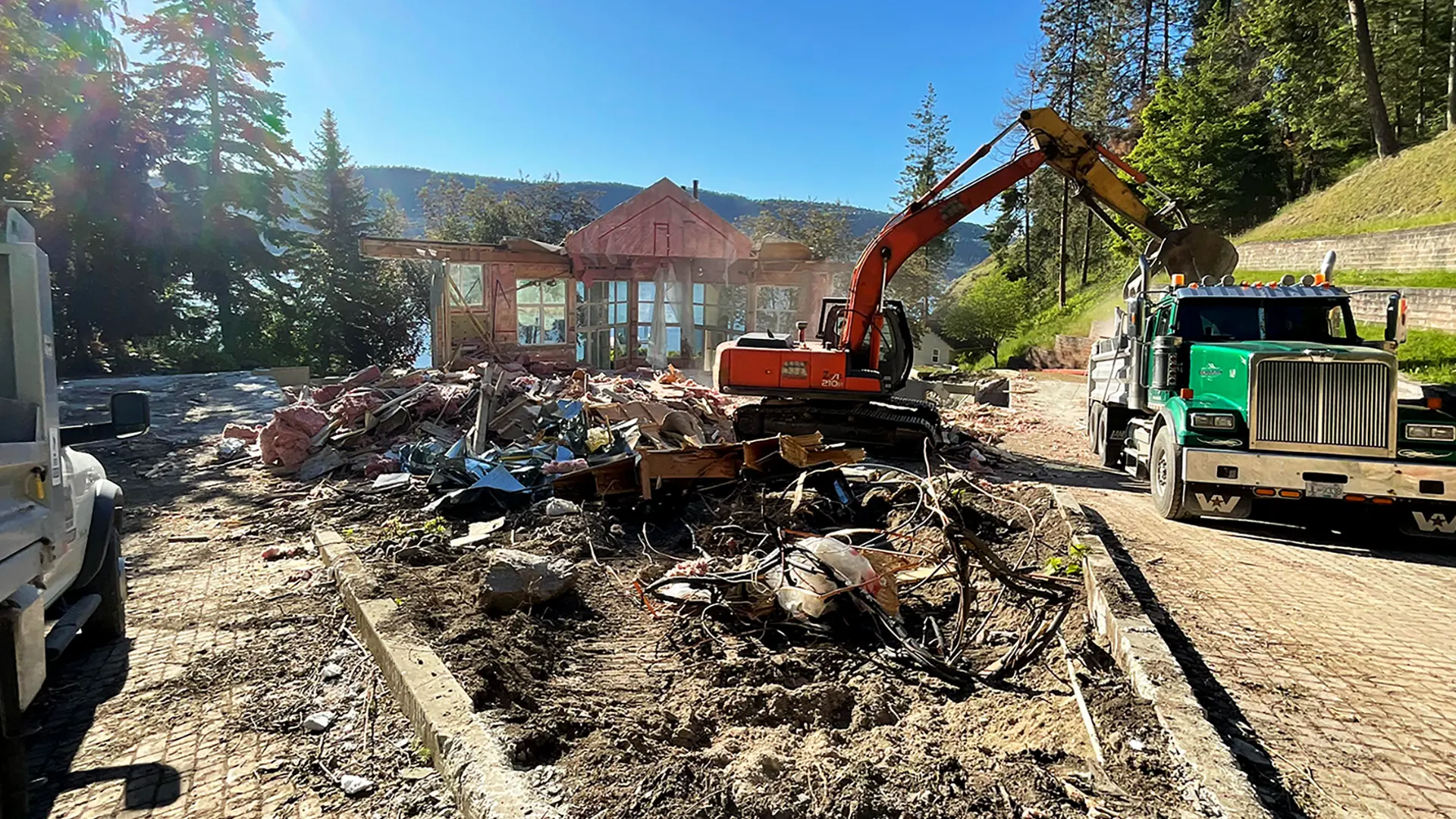
Demolition Excavation in Kelowna
Rock Hard Excavating handles residential and commercial demolition projects throughout Kelowna and the Central Okanagan. This page covers the full process — from the first phone call through final site clearance — including the regulatory requirements that apply in BC and Kelowna specifically.
Before Demolition Can Start
Most property owners underestimate the lead time required before mechanical demolition begins. The two longest items — utility disconnections and the hazardous materials survey — need to be initiated early in the planning process and can run in parallel to compress the overall timeline.
Disconnect All Utilities First
All services must be physically disconnected and capped before demolition begins. This is a WorkSafe BC requirement and a condition of the City of Kelowna demolition permit. Each utility has its own process:
- BC Hydro / FortisBC (electricity): A licensed electrical contractor first isolates the service panel internally, with a Technical Safety BC permit. BC Hydro or FortisBC then sends a crew to remove the service entrance at the pole or transformer. Allow 2–6 weeks lead time — longer in summer months.
- FortisBC (natural gas): A licensed gas contractor caps all internal gas lines, again with a Technical Safety BC permit. FortisBC then removes the meter and caps the service at the property line. Allow 2–4 weeks.
- City of Kelowna (water and sewer): The water service is cut and capped at the property line by a licensed plumber, with City crews capping at the main. Sewer laterals must be plugged or grouted.
- Telecommunications (Telus, Shaw/Rogers): Phone, cable, and internet lines should be arranged for disconnection early — these are generally simpler to coordinate but can cause delays if left to the last minute.
Hazardous Building Materials Survey
Under WorkSafe BC’s OHS Regulation (Section 6.4), a Hazardous Building Materials Survey (HBMS) is mandatory before any demolition in BC — regardless of the building’s age. The survey must be conducted by a qualified, independent professional: typically a Certified Industrial Hygienist (CIH) or Registered Occupational Hygienist (ROH). They cannot be the same party as the abatement contractor.
The survey identifies the presence and location of:
- Asbestos-containing materials (ACMs) — both friable (easily crumbled) and non-friable. Buildings constructed before 1990 are highest risk, but any structure may contain asbestos.
- Lead-based paint
- Mercury — found in older thermostats and fluorescent lamp ballasts
- PCBs (polychlorinated biphenyls) — in older electrical equipment and transformers
- Mould and fuel or oil contamination
Bulk samples of suspected materials are sent to an accredited laboratory for analysis. The surveyor then produces a formal abatement report documenting all hazardous materials by location, type, quantity, and risk classification — along with recommended removal procedures for each.
Abatement — Removing Hazardous Materials
If hazardous materials are found, abatement must be completed before mechanical demolition begins. A WorkSafe BC-registered abatement contractor removes and disposes of the hazardous materials according to the risk classification set out in the abatement report:
- Type 1 and Type 2 asbestos work covers lower-risk, non-friable materials and smaller quantities. Standard PPE and containment procedures apply.
- Type 3 asbestos work (high-risk, friable materials) requires a sealed enclosure, negative air pressure, continuous air monitoring during work, and a clearance air monitoring report after abatement confirms the area is safe before re-entry.
For significant asbestos abatement, WorkSafe BC requires advance notification through their eNotify portal (OHS Regulation Part 6). Once abatement is complete and cleared, the site is ready for mechanical demolition.
- The City of Kelowna requires the abatement report as part of the demolition permit application — the permit will not be issued without it.
- The RDCO Glenmore Landfill may require a copy of the abatement report at the gate before accepting demolished materials from your site.
- The City of Kelowna may require documented proof of proper hazardous material disposal — from your abatement report — before issuing a new building permit on the property.
City of Kelowna Demolition Permit
A demolition permit from the City of Kelowna is required before any structure is demolished. The permit application must include:
- Completed demolition permit application form
- Hazardous building materials survey or abatement report (or a clearance certificate if abatement is already complete)
- Site plan identifying the structure(s) to be removed
- Proof of property ownership or owner authorization
- Utility disconnection confirmations, or letters of intent from each utility
- Erosion and sediment control plan (required for sloped lots or sites near watercourses)
Permit fees are set by the City’s Consolidated Fees Bylaw. For reference, residential demolition permits typically range from $150–$400; accessory structures (garages, sheds) are typically $75–$150. Commercial and industrial structures are assessed differently. Current fees are available from the City of Kelowna Building & Permitting department at 250-469-8500 or at kelowna.ca.
WorkSafe BC also requires written notification at least 24 hours before demolition begins, submitted through the WorkSafe BC eNotify portal (OHS Regulation Section 20.112).
The Demolition
Site Consultation and Assessment
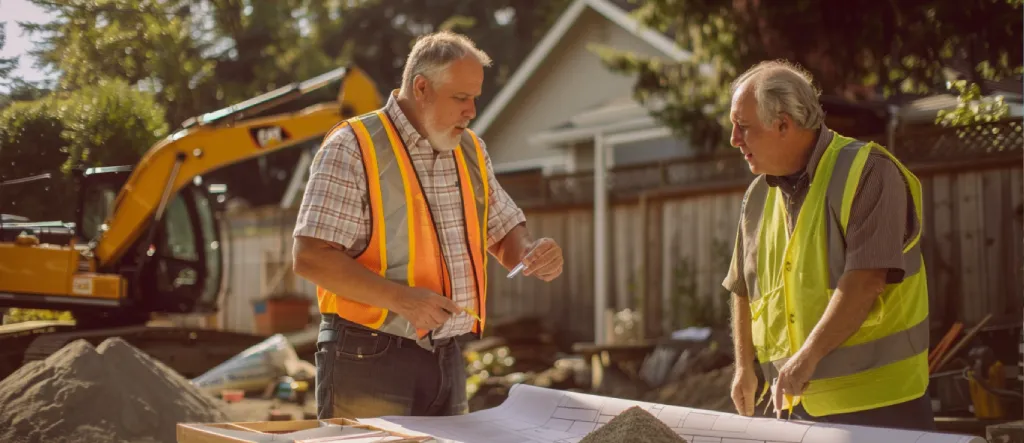
Before scheduling demolition, we meet with you on site for a physical walkthrough. This lets us assess the structure, review equipment access and haul routes, identify any site-specific considerations, and confirm the approach that fits your timeline and budget. During the walkthrough we note the location of materials — concrete, drywall, asphalt shingles, metal, wood framing — so they can be separated efficiently on site for disposal or salvage.
Selective vs. Full Mechanical Demolition
The right approach depends on your timeline, budget, and what the structure contains:
- Selective (staged) demolition: Materials are carefully separated and removed in sequence before or during mechanical demolition. This allows recovery of valuable materials — old-growth timber, copper wiring, heritage brickwork, architectural elements — and reduces landfill volumes and tipping fees. It takes more time but can offset some costs through salvage.
- Full mechanical demolition: The excavator brings the structure down in the most efficient sequence, with on-site sorting of debris loads (concrete, wood, and metal are separated to reduce RDCO tipping fees). Faster timeline, lower labour cost.
A typical single-family residential structure takes one to three days of machine time to bring down and clear.
Waste Disposal and Documentation
The RDCO Glenmore Landfill accepts most demolition debris. Sorted loads — clean concrete, clean wood, metals — typically receive lower tipping rates, which is an incentive to separate materials on site. Mixed loads are accepted at a higher rate.
Asbestos waste is accepted at the landfill’s dedicated asbestos cell, but only when properly packaged:
- Double-bagged in minimum 6-mil polyethylene, sealed, and labelled with the asbestos warning symbol
- Accompanied by a Hazardous Waste Manifest as required under BC’s Environmental Management Act — this document tracks the waste from the point of generation to the disposal facility
Salvageable materials can be sold to local scrap dealers or donated. The Habitat for Humanity ReStore in Kelowna accepts usable cabinets, doors, windows, and fixtures. Donations to registered charities generate a receipt for income tax purposes. Diverting materials from landfill also reduces your overall tipping costs.
Final Inspection and Documentation
Once the site is cleared, we conduct a final walkthrough to confirm the work meets all permit conditions and client specifications. We provide a comprehensive documentation package covering the abatement work completed, waste disposal records, and the final site condition.
This documentation package is your legal record of the project. It will likely be required by the City of Kelowna when you apply for a new building permit on the property, and is a valuable record to retain for future title transfers or insurance purposes.
Typical Project Timeline
Timelines vary by project, but the phases below reflect a realistic picture for a standard residential demolition in Kelowna. Utility disconnections and the permit application can run in parallel with the hazmat survey, which helps compress the overall schedule.
(booking, fieldwork, lab, report)
(can run parallel)
(City of Kelowna processing)
(from project initiation)
The longest lead times are usually BC Hydro disconnection and the permit process. Getting both in motion early is the single most effective way to keep a demolition project on schedule.
What Does a Demolition Cost in Kelowna?
Demolition costs are project-specific. The size of the structure, what the hazmat survey finds, and your timeline all affect the total. Here are the main cost components to plan for:
- Hazardous building materials survey: Typically $500–$2,000+, depending on structure size and complexity
- Abatement: Highly variable — depends entirely on what materials are found and in what quantities. Type 3 asbestos abatement is significantly more involved than Type 1 or 2 work.
- City of Kelowna demolition permit: $150–$400 for most residential structures
- Mechanical demolition and debris removal: Quoted per project after a site assessment
Meaningful ballpark figures for an all-in demolition budget don’t exist — the abatement results can change the scope significantly, which is why the survey comes first and everything flows from there. We provide a detailed quote after an in-person site visit.
Reasons to Choose Rockhard Excavation
Rockhard Excavating has been providing a large variety of excavation services throughout the Okanagan Valley since 2011. This experience has given us a deep understanding of the local geography, including the various types of rock, soil, clay, and how frost patterns can affect construction. This knowledge ensures our services are both durable and suited to the unique conditions of the area.
- Budget Management: We provide clear cost estimates to avoid surprises, ensuring your project stays within budget.
- Timely Completion: We prioritize efficient scheduling to minimize delays, aiming for on-time project completion.
- Quality Assurance: Our focus on high-quality materials and craftsmanship.
- Regulation Expertise: We work closely with our clients to ensure permitting and compliance with local regulations.
- Clear Communication: Expect transparent and consistent updates throughout the project, keeping you informed and involved.
- Respect for Property: We take precautions to prevent damage to your property and surrounding areas during construction.
- Environmental Responsibility: Our methods prioritize minimal environmental impact and sustainable practices.
- Safety First: We adhere to strict safety standards to protect everyone involved, from our workers to your family.